pT Drell-Yan distribution
PSRI09
The large logarithms of the pT distribution of the Drell-Yan process can be summed up analytically at NLL level. The result has very compact form and it is given in the Fourier transform space,
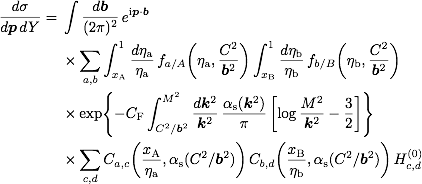
Here p is the transverse momentum of the vector boson, Y its rapidity. Variable xA and xB are the longitudinal momentum fractions of the vector boson,

where M is the invariant mass of the vector boson. More details can be find in paper by Collins, Soper and Sterman. This result consists of Sudakov factor of the kT evolution (third line) and the convolutions of the parton distribution functions (second line) and the structure functions (fourth line).
If we take the Fourier transform of this expression and perform the convolutions, then we have
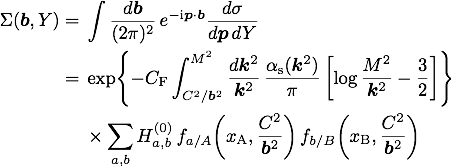
The exponential is the Sudakov factor of the kT evolution and second factor (in the last line) is the Born cross section of the Drell-Yan process.
Now, the idea is to calculate the pT distribution numerically from parton shower program and compare to the analytic result. It is possible to calculate Σ(b, Y) directly but it might be not the best quantity since we would like to compare the exponent. The Born cross section

can be calculated analytically. The shower cross section can be calculated numerically as function of the b, Y and M and we can compare to the analytic result, so we have

In the large b2 limit and in the large M2 limit this equation should be valid. If we get this right from the shower calculation then we can conclude that the given parton shower program is able to sum up the large logarithms of the Drell-Yan pT distribution at NLL level. Of course the outcome of this comparison is shower algorithm dependent, so we have to repeat the procedure with every shower program.
