Vertical Correctors
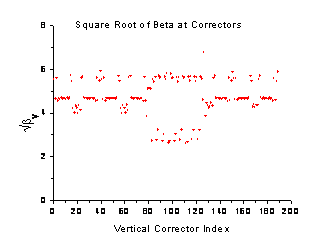
The most effective correction is obtained when the correctors are located as near as possible to the sources of generating the largest orbit deviations, i.e. the quadrupoles. There are a total of 187 vertical corrector magnets in use of slow orbit correction in PETRA III storage ring. Most of the vertical corrector magnets are iron core water cooled magnets. They are placed near to high by points at defocusing quadrupoles. In total they are 96(PCV 27 + PCVM 15+ PKV 42 + PKVW 12) in number including the new DBA section. In the old octants the vertical corrector magnets are incorporated in the sextupole magnets. They are 91(PKVSX 70 + PKVSU 21) in number. According to the accuracy of power supply settings required to obtain beam orbit stability in horizontal plane, the steering magnets setting resolution is ³18 bit.
For estimation of maximum vertical corrector strength, 200 random corrections are made and the maximum corrector strengths are saved. It shows that a maximum of 0.5mrad is sufficient to carry out the slow orbit correction scheme for PETRA III. The results are reproduced below.
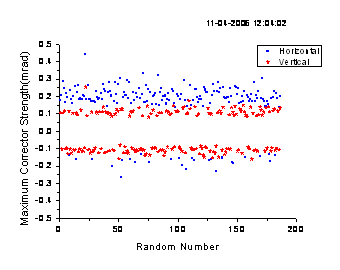
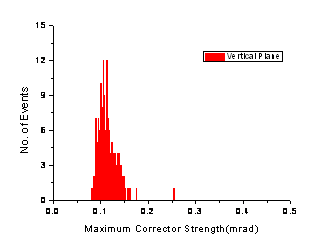
Form the maximum strength of 0.5mrad, the integrated magnetic field required to get such a kick at 6GeV is 100 G.m.
qmax » 0.5mrad Þ Bl= 100G.m
The vertical correctors are classified to 5 categories according to its position and function. The independent slow correctors are named as PCV (PCV.SWR.13 to PCV.SWL.1) in the old octant as they are brought from HERA ring, PKV (PKV.NOR.043 to PKV.OL.58) in the new octant, PKVW (PKVW.WL.25 to PKVW.NR.24) in the damping wiggler sections, the steering magnets in the sextupoles used for chromaticity correction are named as PKVSX (PKVSX.SWR.75 to PKVSX.SWL.75), the steering magnets in the sextupoles not used for chromaticity correction, are named as PKVSU (PKVSU.SWR.46 to PKVSU.SWL.46) and fast corrector magnets are named as PKVSA (PKVSA.WL.37 to PKVSA.SWL.13) in the long straight sections of old octant as well as PKVS (PKVS.NOR.43 to PKVS.OL.60) in the new octant.
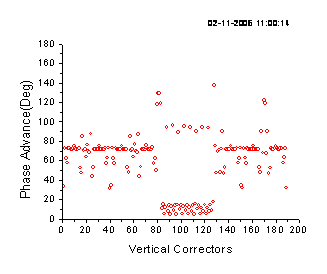
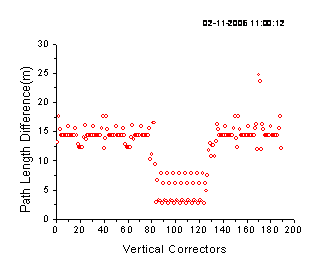
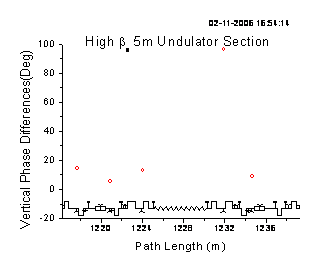
Phase advances among the Vertical Correctors:
Home page of Orbit Movement and Beam Position Control