Fast Orbit Correction
A certain global reference orbit
often referred to as the ``golden orbit'' needs to be established.
Preferably this orbit is going through the centres of quadrupoles and
sextupoles in order to minimize optics distortions which lead to spurious
vertical dispersion and betatron coupling and thus an increased emittance
coupling. Usually some extra steering in the vicinity of the IDs is added. In
order to find this orbit ``beam-based
alignment'' technique is employed which determine the offset of the BPM
zero reading with respect to the magnetic centre of the adjacent quadrupole.
This offset is determined by altering the focusing k+Dk of individual quadrupoles and measuring the
resulting RMS orbit change which is determined by the product of the known Dk and
the initial orbit excursion at the location of the modulated quadrupole. A
comparison with the corresponding reading of the adjacent BPM reveals the
offset. Even for well aligned machines these offsets can be of the order of a
few 100 mm since they represent a
convolution of mechanical and electronical properties of the BPMs. As a result
the remaining DC RMS corrector strength is usually significantly reduced when
correcting to the ``golden orbit''. The correlation between correctors and BPMs
is established by superimposing the BPM pattern for the excitation of every
single corrector. Very often the horizontal and vertical planes are treated
independently assuming a small betatron coupling. The coefficients of the two
resulting correlation matrices also called response matrices can be derived
analytically from the machine model or from orbit measurements. To turn this
into a correction algorithm it is necessary to ``invert'' the matrices in order
to get the corrector pattern as a function of a given BPM pattern. If the
correlation matrix is a square  x
matrix and has independent
eigenvectors and is not ill-conditioned this is easy to accomplish and one gets
a unique solution for the problem by matrix inversion. In reality the number of
correctors and BPMs can be already different by design or due to BPM failures
and magnet saturations. As a result the matrix is non-square and the solution
is no longer unique. A very flexible way to handle these scenarios is offered
by the SVD algorithm. This numerically very robust method minimizes the RMS
orbit and the proposed RMS corrector strength changes at the same time if the
number of correctors is larger than the number of BPMs whilst the RMS orbit is
minimized in the reverse case. By introducing cutoffs in the eigen value
spectrum for small eigen values only the most effective corrector combinations
are selected and the correction gets less sensitive to BPM errors. Thus this
technique makes ``Most Effective Corrector'' and ``MICADO'' like long range
correction schemes superfluous. Since modern light sources are built with very
tight alignment tolerances and BPMs are well calibrated with respect to
adjacent quadrupoles, orbit correction by matrix inversion in the x case which is
equivalent to an SVD employing all eigenvalues has become an option since the
resulting RMS corrector strength is still moderate (typically
x
matrix and has independent
eigenvectors and is not ill-conditioned this is easy to accomplish and one gets
a unique solution for the problem by matrix inversion. In reality the number of
correctors and BPMs can be already different by design or due to BPM failures
and magnet saturations. As a result the matrix is non-square and the solution
is no longer unique. A very flexible way to handle these scenarios is offered
by the SVD algorithm. This numerically very robust method minimizes the RMS
orbit and the proposed RMS corrector strength changes at the same time if the
number of correctors is larger than the number of BPMs whilst the RMS orbit is
minimized in the reverse case. By introducing cutoffs in the eigen value
spectrum for small eigen values only the most effective corrector combinations
are selected and the correction gets less sensitive to BPM errors. Thus this
technique makes ``Most Effective Corrector'' and ``MICADO'' like long range
correction schemes superfluous. Since modern light sources are built with very
tight alignment tolerances and BPMs are well calibrated with respect to
adjacent quadrupoles, orbit correction by matrix inversion in the x case which is
equivalent to an SVD employing all eigenvalues has become an option since the
resulting RMS corrector strength is still moderate (typically  100 mrad), BPMs
are reliable and their noise is small (no BPM averaging is performed which is
similar to a local feedback scenario). This allows to establish any desired
``golden orbit'' within the limitations of the available corrector strength and
the residual corrector/BPM noise. For the horizontal orbit correction it is
crucial to take into account path-length effects due to circumference or rf
frequency changes by correcting the corresponding dispersion orbits by means of
the rf frequency. A gradual build-up of a dispersion related corrector pattern
with a nonzero mean must be avoided since this leads together with an rf
frequency change to a corrected orbit at a different beam energy. Thus it is
desirable to subtract the pattern from the actual corrector settings before
orbit correction in order to remove this ambiguity. In order to implement a
global orbit feedback based on the described algorithm which stabilizes the
electron beam with respect to the established ``golden orbit'' up to
frequencies 100 Hz
BPM data acquisition rates of at least 1-2 kHz
are needed. If sub-micron in-loop orbit stability is required the integrated
noise contribution from the BPM electronics must not exceed a few hundred nanometers
which is achieved with modern digital four channel (parallel) BPM as well as analog
multiplexed systems. A fast network needs to be established which distributes
the acquired BPM data around the ring or to a central point in order to be able
to determine the individual correction values which in general depend on all
BPM readings. Since the necessary matrix multiplications with the BPM vector can
be parallelized a distribution on several CPU units handling groups of
correctors is a natural solution. Furthermore the ``inverted'' matrix can be
sparse depending on the BPM/corrector layout such that most of the off-diagonal
coefficients are zero. In these cases only a small subset of all BPM readings
in the vicinity of the individual correctors determines their correction
values. The feedback loop is usually closed by means of a PID controller
function optimizing gain, bandwidth and stability of the loop. Notch filters
allow to add additional ``harmonic suppression'' of particularly strong
lines in the noise spectrum.
100 mrad), BPMs
are reliable and their noise is small (no BPM averaging is performed which is
similar to a local feedback scenario). This allows to establish any desired
``golden orbit'' within the limitations of the available corrector strength and
the residual corrector/BPM noise. For the horizontal orbit correction it is
crucial to take into account path-length effects due to circumference or rf
frequency changes by correcting the corresponding dispersion orbits by means of
the rf frequency. A gradual build-up of a dispersion related corrector pattern
with a nonzero mean must be avoided since this leads together with an rf
frequency change to a corrected orbit at a different beam energy. Thus it is
desirable to subtract the pattern from the actual corrector settings before
orbit correction in order to remove this ambiguity. In order to implement a
global orbit feedback based on the described algorithm which stabilizes the
electron beam with respect to the established ``golden orbit'' up to
frequencies 100 Hz
BPM data acquisition rates of at least 1-2 kHz
are needed. If sub-micron in-loop orbit stability is required the integrated
noise contribution from the BPM electronics must not exceed a few hundred nanometers
which is achieved with modern digital four channel (parallel) BPM as well as analog
multiplexed systems. A fast network needs to be established which distributes
the acquired BPM data around the ring or to a central point in order to be able
to determine the individual correction values which in general depend on all
BPM readings. Since the necessary matrix multiplications with the BPM vector can
be parallelized a distribution on several CPU units handling groups of
correctors is a natural solution. Furthermore the ``inverted'' matrix can be
sparse depending on the BPM/corrector layout such that most of the off-diagonal
coefficients are zero. In these cases only a small subset of all BPM readings
in the vicinity of the individual correctors determines their correction
values. The feedback loop is usually closed by means of a PID controller
function optimizing gain, bandwidth and stability of the loop. Notch filters
allow to add additional ``harmonic suppression'' of particularly strong
lines in the noise spectrum.
The effect of the minimum
applicable correction strength which is defined by the PS resolution for a
given current range must be within the BPM noise and is typically of the order 10 nrad corresponding to 18 bit
(4 ppm)
resolution for a PS with ±1 mrad
maximum strength. Modern PS with digital control have reached noise figures of
<1 ppm providing kHz small-signal bandwidth, which opens the
possibility to use the same correctors for DC and fast correction. Eddy
currents induced in the vacuum chamber should not significantly attenuate or
change the phase of the effective corrector field up to the data acquisition
rate. Since eddy currents are proportional to the thickness and electrical
conductivity of materials, only thin laminations (£1 mm thickness) or air coils should be used for correctors
and low conductive materials preferred for vacuum chambers. Eddy currents in
vacuum chambers usually impose the most critical bandwidth limitation on the
feedback loop. Global fast orbit feedbacks are operational or have been
proposed for a large number of light sources, see Table 2. ALS, APS, ESRF,
NSLS, SLS and Super-ACO (operated <12/03) have running configurations in
user operation. BESSY, DELTA, SPEAR3 and SPring-8 have proposals; some of them
test setups too. The upcoming machines DIAMOND and SOLEIL have proposals for
fast global orbit feedbacks.
|
Table 2: Compilation of operational global, proposed global and operational local fast orbit feedback systems at light sources |
|||
|
SR Facility |
BPM Type |
max. BW |
Stability |
|
ALS |
RF-BPMs |
<50 Hz |
<1 mm |
|
APS |
RF&X-BPMs |
50 Hz |
<1 mm |
|
ESRF |
RF-BPMs |
100 Hz |
<0.6 mm |
|
NSLS |
RF&X-BPMs |
<200 Hz |
1.5 mm |
|
SLS |
RF&X-BPMs |
100 Hz |
<0.3 mm |
|
Super-ACO |
RF-BPMs |
<150 Hz |
<5 mm |
|
BESSY |
RF-BPMs |
<100 Hz |
<1 mm |
|
DELTA |
RF-BPMs |
<150 Hz |
<2 mm |
|
DIAMOND |
RF-BPMs |
150 Hz |
0.2 mm |
|
SOLEIL |
RF-BPMs |
150 Hz |
0.2 mm |
|
SPEAR3 |
RF-BPMs |
100 Hz |
<3 mm |
|
SPring-8 |
RF-BPMs |
100 Hz |
<1 mm |
|
APS |
X-BPMs |
50 Hz |
<1 mm |
|
BESSY |
X-BPMs |
50 Hz |
<1 mm |
|
ELETTRA |
RF-BPMs |
80 Hz |
0.2 mm |
Local fast orbit feedbacks (see Table 2) stabilize orbit position and
angle at ID centres locally without affecting the orbit elsewhere which is
accomplished by a superposition of symmetric and asymmetric closed orbit bumps
consisting of ³4 correctors per plane
around the ID. Photon BPMs (X-BPMs) which are located in the beam line frontends
measuring photon beam positions provide very precise information about orbit
fluctuations at the ID source point at a typical bandwidth of 2 kHz. With two X-BPMs position and angle fluctuations
can be disentangled. Unfortunately the reading depends on the photon beam
profile and thus on the individual ID settings. APS is operating X-BPM based
feedbacks on their dipole and ID X-BPMs at fixed gap. BESSY has the prototype
for an X-BPM based feedback on an APPLE II ID. ELETTRA implemented a
feedback for an electromagnetic elliptical wiggler (EEW) based on a new type of
digital ``low gap'' BPM. If several global and/or local feedbacks are operated
they need to be decoupled. Either they are well separated in frequency which
evidently leads to correction dead bands or they run in a cascaded master-slave
configuration.
Fast orbit Correction simulation for PETRA III:
The intermediate golden orbit is determined by means of a slow orbit correction using 219 BPMs, 189 horizontal and 189 vertical corrector magnets. During the slow orbit correction the horizontal dispersion is simultaneously corrected along with the orbit taking a small weighting factor (~0.03). The tune is corrected using the main Qf and Qd quadrupoles. Once this intermediate golden orbit is obtained, then spurious vertical dispersion is corrected using 12 skew quadrupoles. After the spurious vertical dispersion correction the skew quadrupole and corrector strengths are saved for further use. The orbit thus obtained is saved as a golden orbit.
Form the ground vibration studies at PETRA III tunnel it is found out that the integrated displacement up to few Hz is ~ 128nm. For a worst case scenario ground motion amplitude of 1mm is applied as random displacements to quadrupoles with different random numbers truncated at 2s. The results of such studies are produced below for reference.
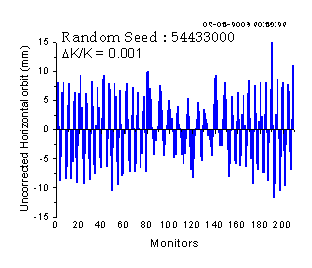
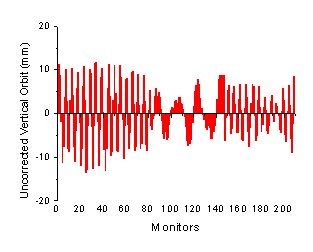
The perturbed orbits obtained for a special case with Random Number 5443300 for magnet misalignment and field errors. After the slow orbit and dispersion correction, the golden orbits are obtained.
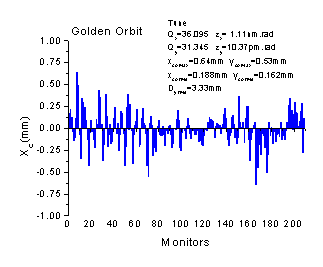
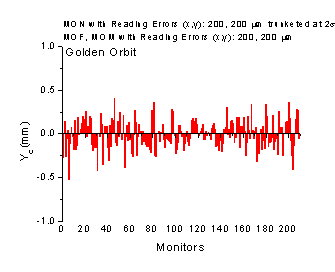
The above golden orbit is perturbed with the application of ground motion with amplitude of 1mm. The perturbed orbits are,
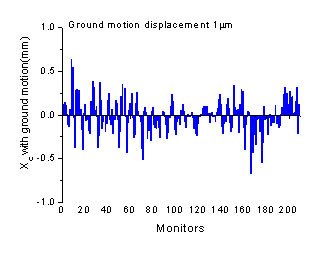
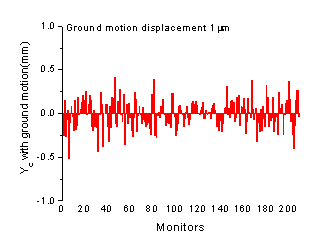
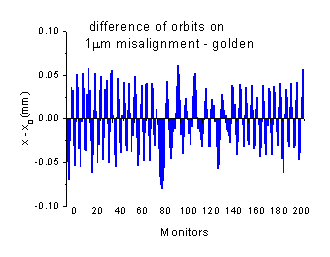
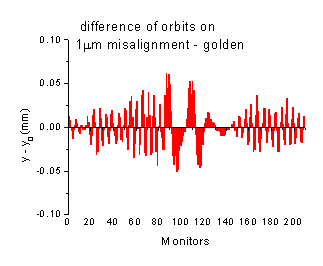
The orbit differences with the golden orbit and the perturbed orbit is quite significant, at least ~±60mm. This perturbed orbit is corrected using all the available monitors and 41 fast corrector on either plane. There are 30 fast correctors located in the new DBA section and 11 fast correctors are located in old octants. In long straight sections, two fast correctors are placed on either ends while one fast corrector is placed in short straight section. This distribution is done with a view that it will minimise the orbit distortion to some extent in old octant. The fast orbit correction is done with a SVD algorithm taking different number of monitors and different weight factors for monitors.
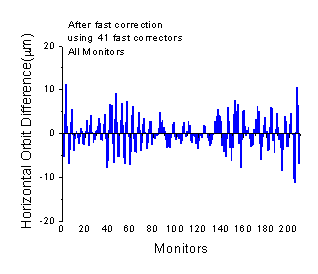
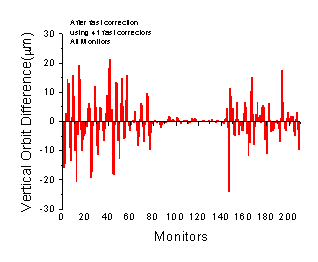
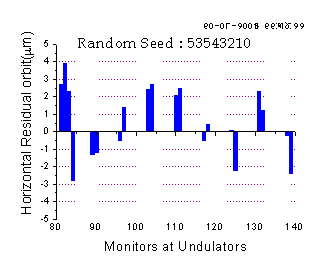
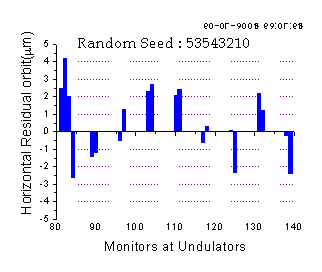
After the fast orbit correction, the residual orbits are reduced. The orbits are better corrected in the new DBA octant. The residual orbits on either side of the insertion devices are most important. The following figures show the orbits at the fast monitors in the new DBA octant.
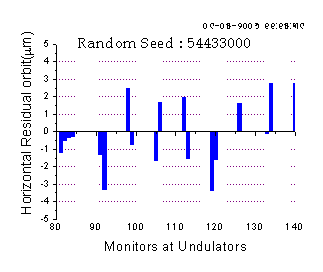
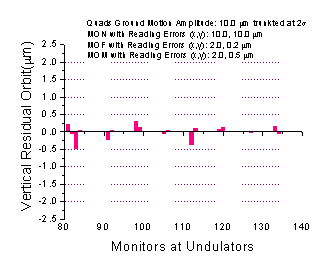
Form this study, it is seen that the residual orbits are with in the limits of 3.5mm in the horizontal plane and 0.5mm in the vertical plane, which are the stability requirements.
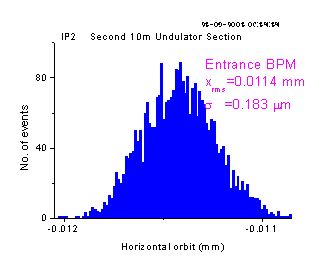
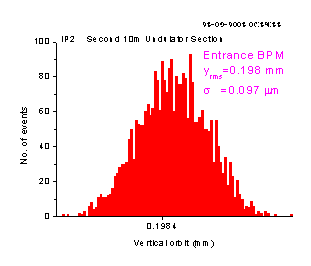
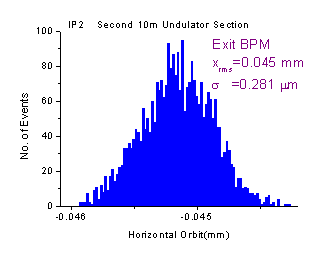
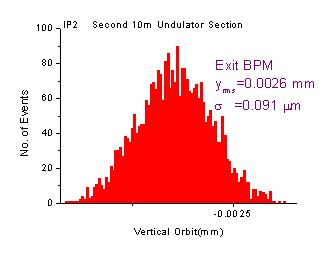
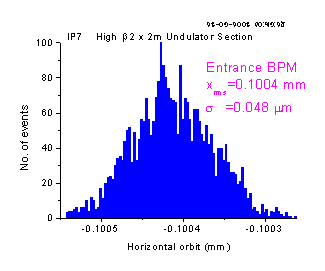
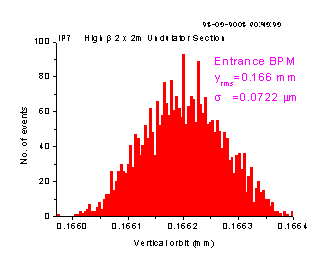
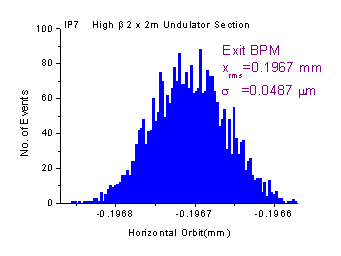
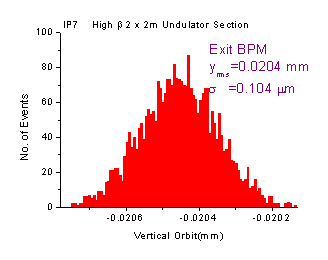
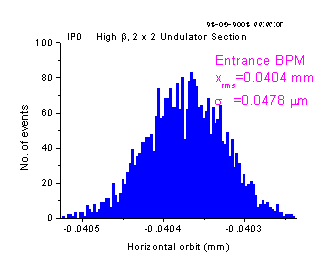
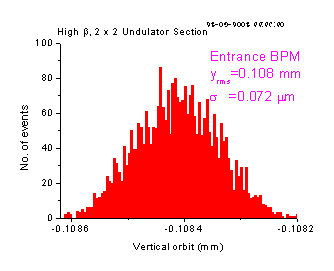
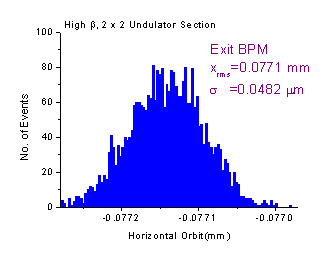
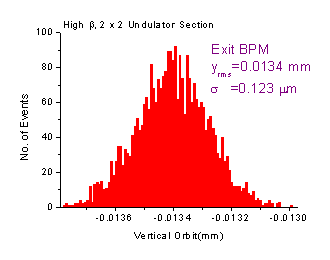
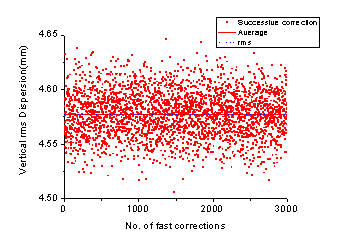
This procedure was adopted for fast orbit correction. Successively for 3000 random seeds with a ground displacement of 500nm, this correction procedure was repeated and the orbit was monitored at the fast BPM locations. The results are produced below.
Orbits at the entrance and exit point of 1st 10m undulator section.
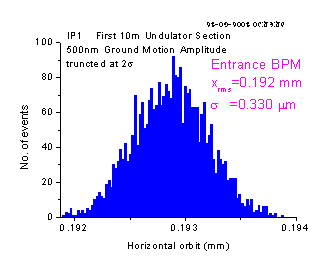
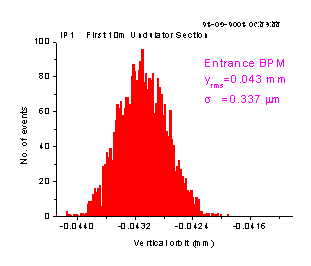
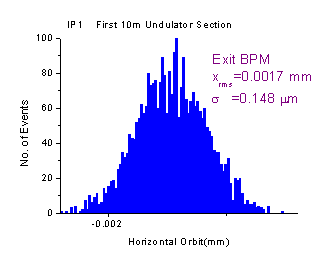
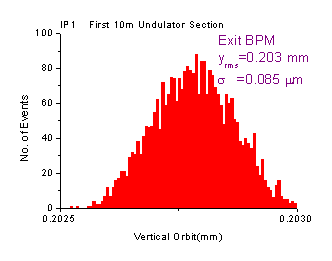
Orbits at the entrance and exit point of 2nd 10m undulator section.
Orbits at the entrance and exit point of High beta 5m undulator section.
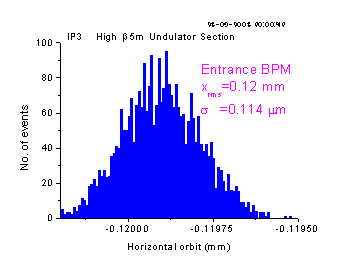
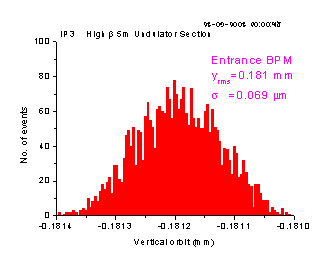
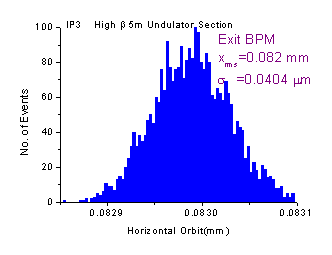
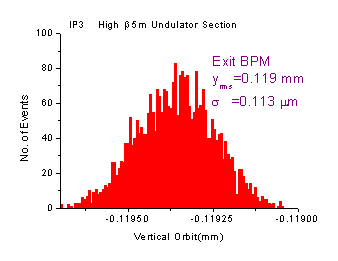
Orbits at the entrance and exit point of High beta 2x2m undulator section.
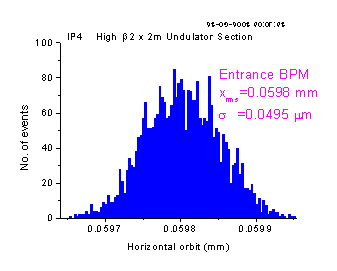
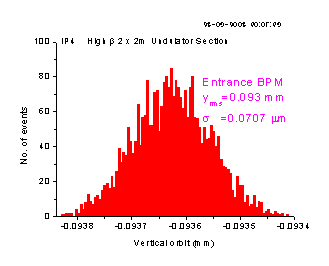
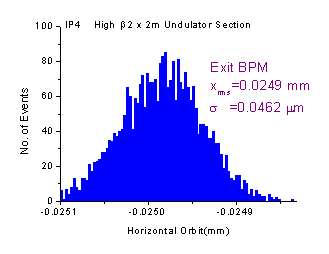
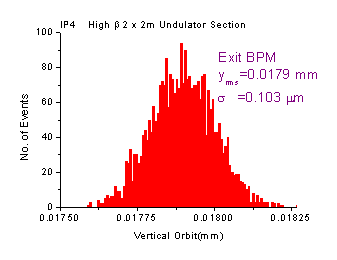
Orbits at the entrance and exit point of low beta 2x2m undulator section.
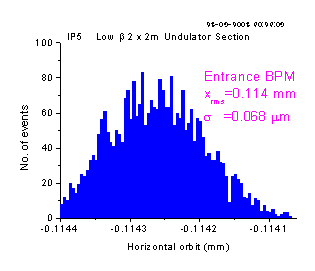
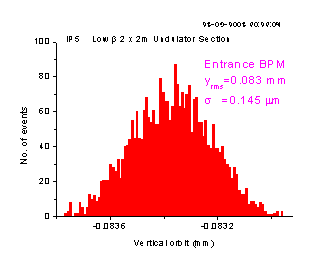
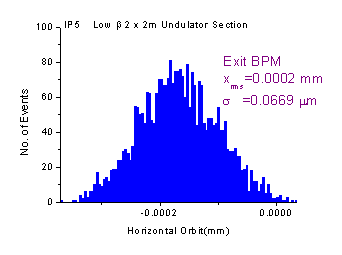
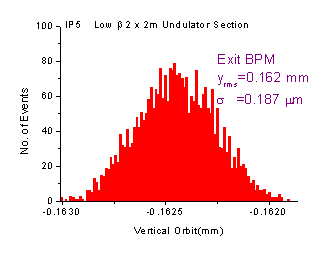
Orbits at the entrance and exit point of High beta 5m undulator section.
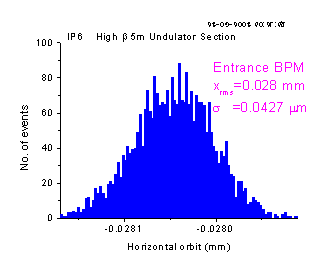
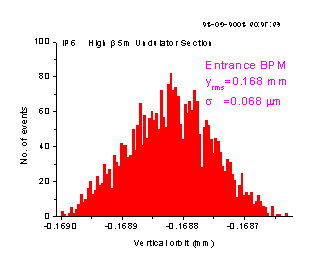
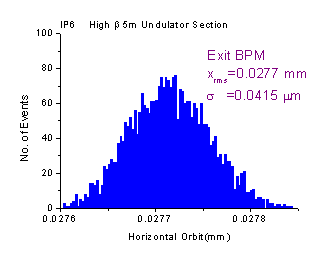
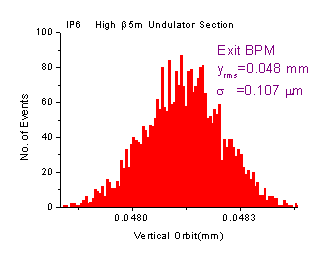
Orbits at the entrance and exit point of High beta 2X2m undulator section.
Orbits at the entrance and exit point of low beta 5m undulator section.
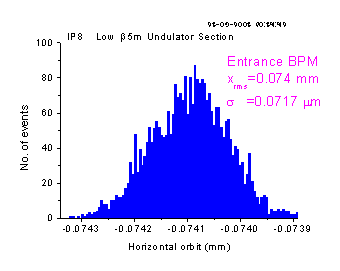
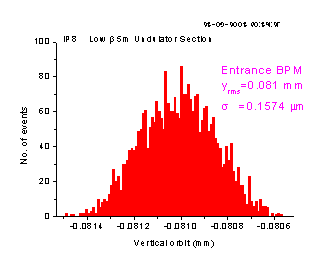
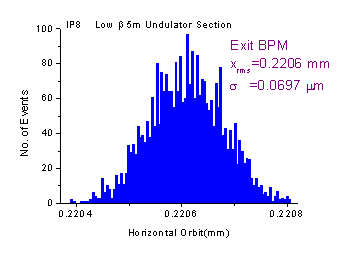
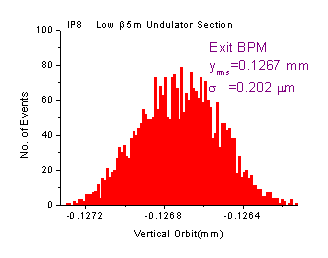
Orbits at the entrance and exit point of High beta 2x2m undulator section.
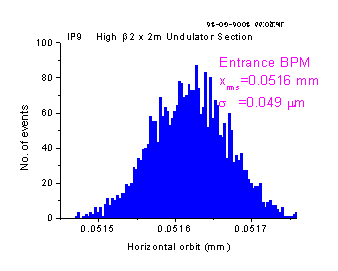
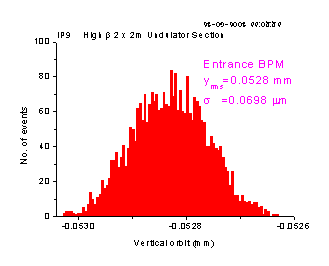
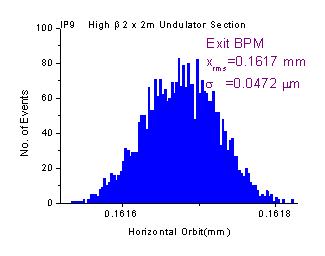
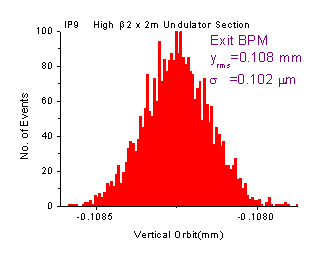
Orbits at the entrance and exit point of High beta 2X2m undulator section.
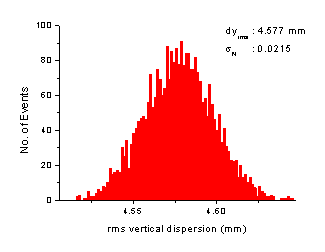
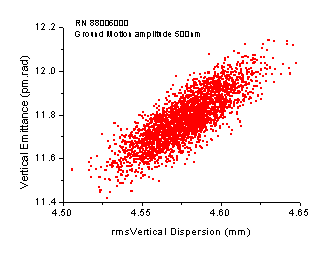
Distribution of rms vertical dispersion for 3000 fast orbit correction cases.
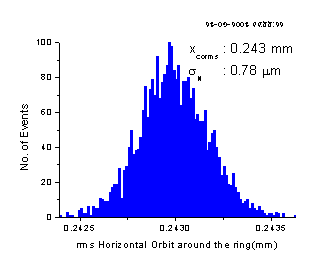
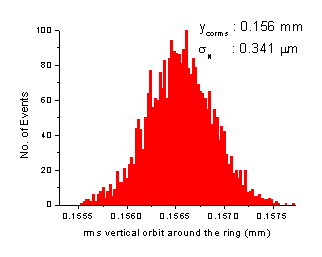
Distribution of rms horizontal and vertical orbits for 3000 fast orbit correction cases.
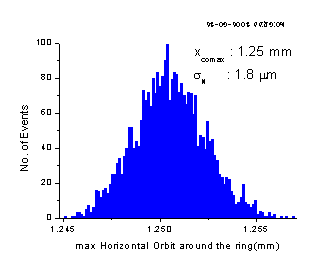
Distribution of maximum horizontal and vertical orbits for 3000 fast orbit correction cases.
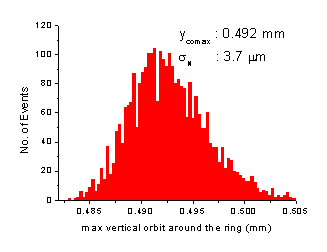
Distribution of horizontal and vertical emittances for 3000 fast orbit correction cases.
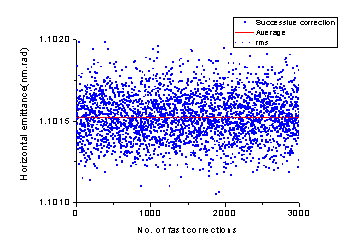
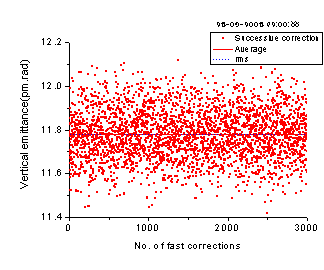
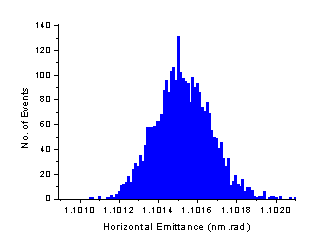
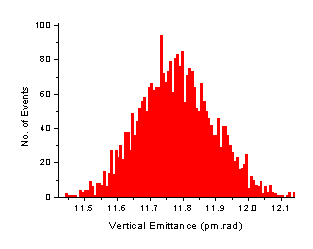
The emittance growths are with in 20% admissible limits. In such studies it is found that the maximum fast corrector strengths are with in 5mrad. This is the case when the fast ground motions are not additive. The 500nm to 1mm ground motion is applied always to the golden orbit.
Fast Orbit Correction with cumulative ground motion:
Unlike the previous case, the ground motion errors are added up in this example. Here the old octant quadrupoles are misaligned with 50nm where as in new octant the quadrupoles are misaligned with 25nm. The errors are truncated at 2s and 1000 random numbers are considered. The fast orbit correction was carried out with all 209 monitors and 41 fast correctors in each plane. As the errors are have to be added up, so the simulation was not straight forward. Each time the errors are saved and the new error was added to it. The results of such a cumulative ground motion studies are:
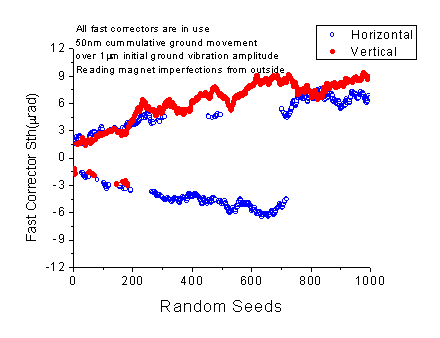
This shows gradual increase in fast corrector strengths which is expected. Keeping this increase in mind the maximum fast corrector strength required is ±15mrad. As shown below the emittances are no more with in the 20% growth limits. Then before the orbits are increased more than 10% of its size the slow orbit correction is to be initiated. So, it is decided to have a fast orbit correction at about 100 Hz and a slow orbit correction around an Hz or below.
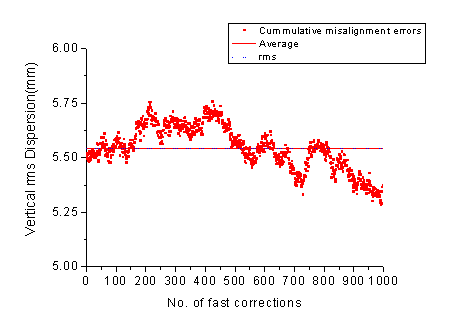
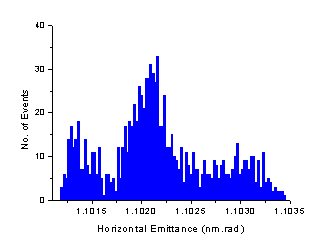
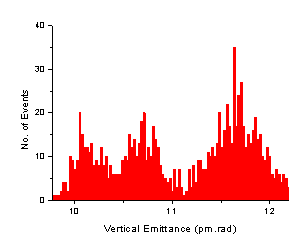
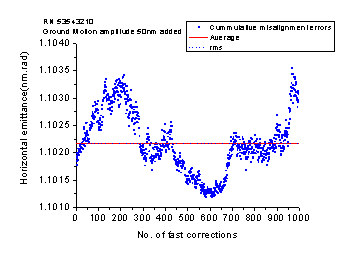
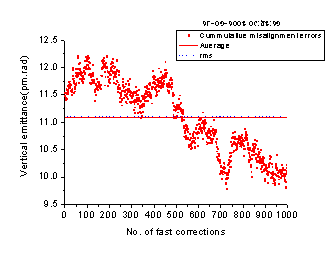
The resulted horizontal and vertical beam emittances are showing drifting behaviour and increasing beyond 20% growth limits.
Orbits at the entrance and exit point of 1st 10m undulator section.
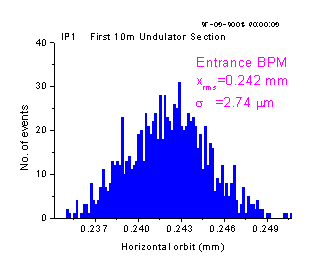
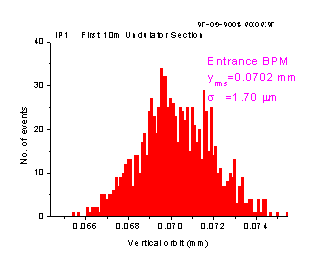
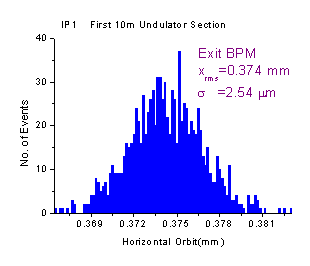
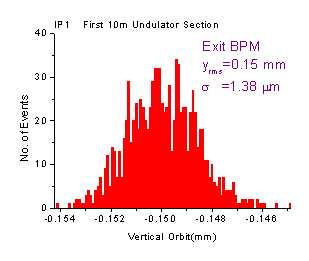
Here you can see that the orbit spreads are more.
Fast Orbit Correction with correlated ground motion:
In this simulation, all the quadrupoles are correlated. No random errors are considered for ground motion except for golden orbit case which is due to misalignment and field errors of magnets. In correlated case, all the quadrupoles are given same misalignment ground vibration. Here the simulations are done for different correlated displacements.
The orbit is corrected with 209 monitors and 41 fast orbit correctors using SVD in either plane.
Results of the fast orbit correction with 1mm correlated ground motion:
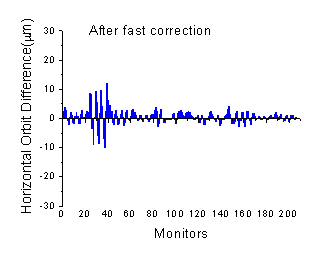
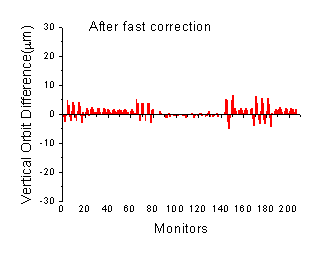
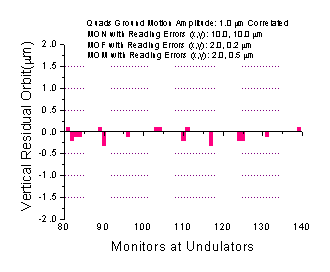
The stability requirement is met. The fast monitors are considered with a weighting factor of 10. The maximum fast corrector strengths are 1.41mrad in horizontal and -0.94mrad in vertical plane. The resulted beam emittances are 1.10nm.rad and 11.38pm.rad in respective planes.
Results of the fast orbit correction with 3mm correlated ground motion:
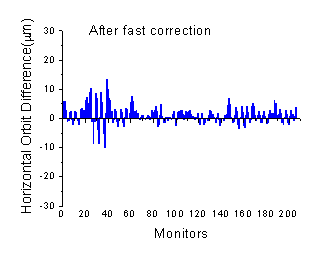
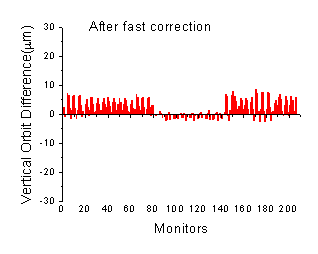
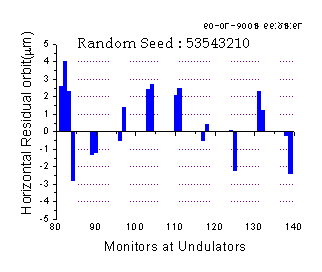
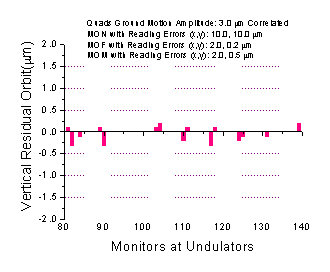
The stability requirement is met. The fast monitors are considered with a weighting factor of 10. The maximum fast corrector strengths are 1.62mrad in horizontal and -1.72mrad in vertical plane. The resulted beam emittances are 1.10nm.rad and 11.49pm.rad in respective planes.
Results of the fast orbit correction with 5mm correlated ground motion:
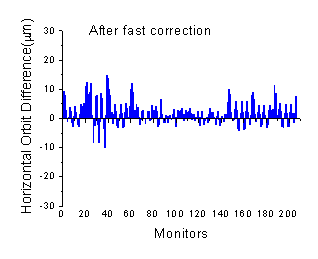
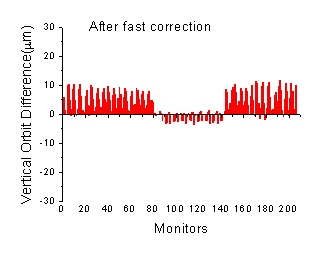
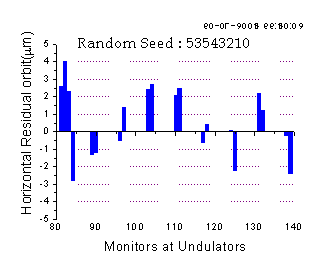
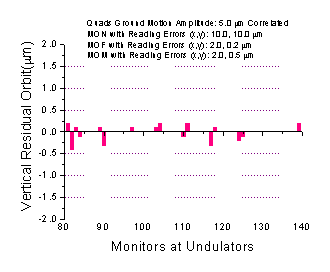
The stability requirement is met. The fast monitors are considered with a weighting factor of 10. The maximum fast corrector strengths are 2.18mrad in horizontal and -2.50mrad in vertical plane. The resulted beam emittances are 1.10nm.rad and 11.60pm.rad in respective planes.
Results of the fast orbit correction with 10mm correlated ground motion:
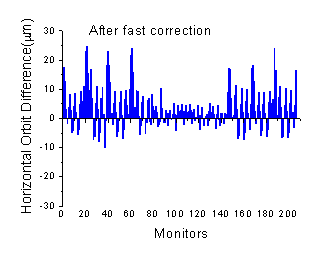
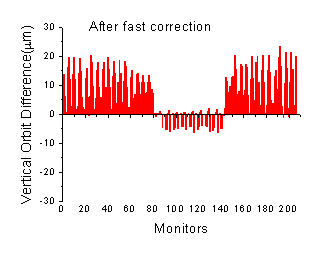
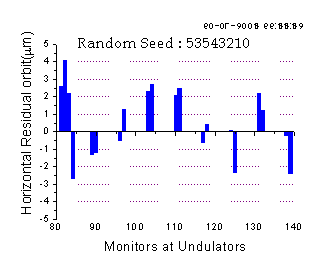
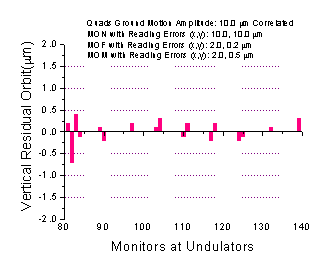
The stability requirement is met except in the 20m undulator section. The fast monitors are considered with a weighting factor of 10. The maximum fast corrector strengths are -3.97mrad in horizontal and -4.4mrad in vertical plane. The resulted beam emittances are 1.10nm.rad and 11.80pm.rad in respective planes.
Results of the fast orbit correction with 20mm correlated ground motion:
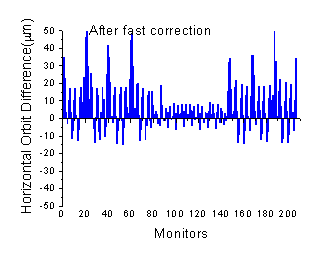
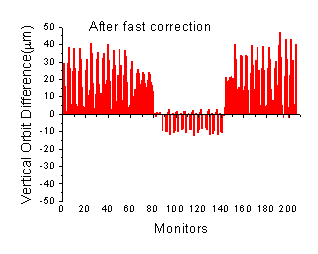
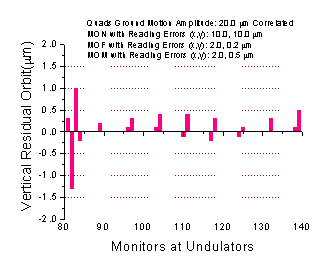
The stability requirement is met except in the 20m undulator section. The fast monitors are considered with a weighting factor of 10. The maximum fast corrector strengths are -7.77mrad in horizontal and -6.5mrad in vertical plane. The resulted beam emittances are 1.10nm.rad and 12.45pm.rad in respective planes.
It is seen that by applying correlated displacements from 1 to 20mm, the horizontal beam emittance does nit change and the vertical beam emittance with the 20% growth limit. But the fast corrector kick strength has increased by a factor of 10.
In another attempt to study the effect of correlated ground motion, 100nm ground displacement was cumulatively added up for 500 iterations without any random nature. The results are produced below for emittances and maximum corrector strengths. In this case the correction is done by using all monitors and the available 59 CHL horizontal correctors and 98 CVL vertical correctors.
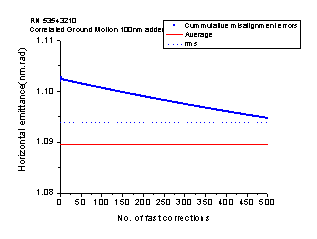
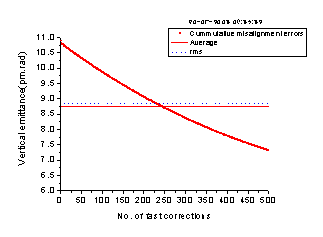
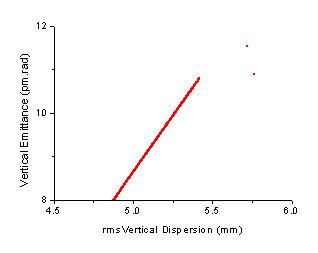
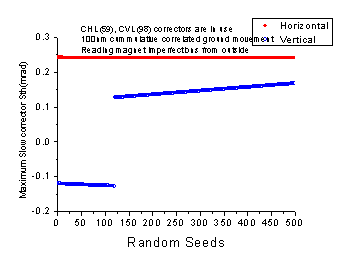
In this study it is seen that the corrector strength are with in the limit, the vertical emittance drifts more than the 20% limit. So, it is desirable to have a new closed orbit correction to maintain the orbit and the emittance before they get perturbed much.
300 random seeds simulation for 100nm cumulative correlated errors.
Yet in another attempt to study the effect of correlated ground motion, 100nm ground displacement was cumulatively added up for 300 iterations without any random nature. The results are produced below for emittances and maximum corrector strengths. In this case the correction is done by using all monitors and the available 41 CHF horizontal fast correctors and 41 CVF vertical fast correctors. This is to simulate effect of temperature rise at different locations around the ring. It is known that the old octants are aligned roughly twice the alignment tolerances of the new octant as the quadrupoles are weak in strength. In present PETRA II tunnel temperature rises ~2°C over a period of a day or so.
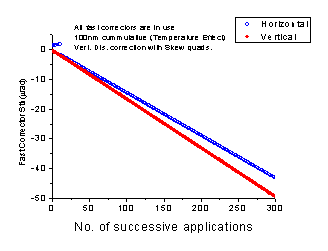
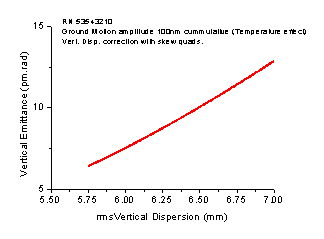
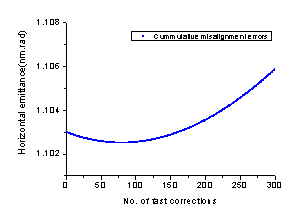
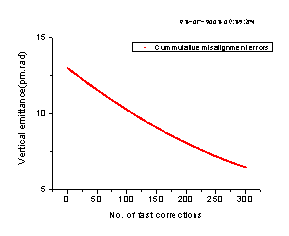
In this case, though the horizontal emittance is not much affected in comparison to vertical beam emittance, for 300 random seeds the required fast corrector strengths are very high. Temperature rise is a slow effect and meanwhile many a times orbit corrections might have carried out.
Home page of Orbit Movement and Beam Position Control