Spurious Vertical Dispersion Correction for PETRA III
introduction
PETRA III is a new light source being reconstructed out of the existing storage ring PETRA II at beam energy of 6 GeV and 100mA stored current with the betatron tune values (36.095, 31.345). The conversion of this 2.304km PETRA II storage ring will include the total rebuilding of one eighth of the storage ring to provide space for nine straight sections to install insertion devices. The new light source which is a hybrid lattice with FODO and DBA(Double Bend Achromat) cells, provides a horizontal beam emittance of 1nm.rad and a 1% emittance ratio, needs careful magnet alignments, orbit stabilization and closed orbit corrections. Side by side the small vertical emittance imposes tight tolerances on the spurious vertical dispersion that is created by misalignment and rotation of the magnets. The average vertical dispersion is a prominent parameter which can lead to significant increase in beam size and hence lower beam brightness. To maintain the emittance ratio and the vertical beam sizes thus enhanced by vertical dispersion at the crucial insertion sections the vertical dispersion has to be corrected. Our goal is to reduce vertical dispersion as per the Table-1 and the betatron coupling in the ring so that the vertical beam size can stay with in an acceptable value.
|
|
Horz. (mm) |
Vert. (mm) |
|
Wiggler section |
18 |
5 |
|
Undulator‘s (ID‘s) |
20 |
3 |
|
FODO arc |
|
58 |
|
DBA |
22 |
31 |
Table 1: Dispersion limits at specific sectors to achieve design emittance.
VERTICAL Dispersion Correction
For PETRA III orbit correction and dispersion correction has to be included as the horizontal dispersion function in the wiggler and undulator sections has to be controlled. Three different schemes are chosen for orbit and dispersion correction in the aforesaid ring. They are discussed in the following paragraphs.
Case 1: The closed orbit and the dispersion are corrected simultaneously using all beam position monitors (BPMs) and the correctors. An algorithm for the simultaneous optimization of the closed orbit and the dispersion is applied. This algorithm is given by the following system of linear equations:
 [1]
[1]
With  being
the closed orbit and
being
the closed orbit and  the dispersion measured at
the BPMs, R the orbit response matrix, S the dispersion response matrix and
the dispersion measured at
the BPMs, R the orbit response matrix, S the dispersion response matrix and  corrector
kicks. a is a weighting factor used to shift from a pure orbit
(a=1) to a pure dispersion correction (a=0). Singular Value Decomposition (SVD) [6] has been proven to be a
numerically robust method to solve such an equation. Closed orbit and dispersion correction has been
simulated to verify that the desired vertical and horizontal emittance can be
achieved.
corrector
kicks. a is a weighting factor used to shift from a pure orbit
(a=1) to a pure dispersion correction (a=0). Singular Value Decomposition (SVD) [6] has been proven to be a
numerically robust method to solve such an equation. Closed orbit and dispersion correction has been
simulated to verify that the desired vertical and horizontal emittance can be
achieved.
After the closed orbit correction, the major contribution to the spurious vertical dispersion comes from, the vertical misalignment of sextupoles, the kick induced by the vertical closed orbit at the sextupoles, tilted quadrupoles, the kick induced by the vertical closed orbit in the quadrupoles. All these errors need to be eliminated or minimised in order to achieve a lower vertical emittance of the stored beam.
Case 2: The closed orbits and horizontal dispersion are corrected as per the above procedure and later vertical dispersion is corrected using 12 skew quadrupoles. These skew quadrupoles are placed at three straight sections in the dispersive region of FODO arcs. A pair of skew quadrupoles is placed around a phase difference of 72° near high beta points on either side of damping wiggler section and new DBA section. The local vertical dispersion and its derivatives are corrected using local bump method by means of 4 skew quadrupoles in the damping wiggler section. It is performed by setting the dispersion and its derivative to zero at the second skew quadrupole in front, and setting the dispersion and its derivative to the previously determined periodic conditions at the second skew quadrupole in back. So, the vertical dispersion and its derivative are optimised by means of matching of required parameters at appropriate azimuthal locations with skew quadrupoles.
A horizontal orbit offset through a skew quadrupole will generate a deflection in the vertical plane through an angle Dqy = k1slx. This will generate a vertical orbit distortion of Dy such that,

With x = Dx DP/P and y = Dy DP/P, one can write the skew quadrupole response matrix as
 [2]
[2]
In this case, the vertical dispersion can be globally minimised at the monitor locations using a SVD algorithm solving for a system of linear equations in Eq.2. The vertical dispersion in the new DBA section, where the insertion devices are placed is minimised using this algorithm.
Case 3: In 3rd case, first the closed orbits and the horizontal dispersion are corrected as described in procedure of Case 1. Later, the vertical dispersion is globally corrected using a few numbers of selected beam position monitors and 21 vertical correctors in the old octants using SVD algorithm.
RESULTS AND DISCUssions
The closed orbit is obtained using the MAD.x program in the presence of damping wigglers and synchrotron radiation. The closed orbit and the dispersion corrections necessary as described above are carried out using a self developed program that solves a system of linear equations using SVD algorithm. As described in the previous section, the vertical dispersion was corrected in three different procedures and the pros and cons are discussed below.
Case 1: The closed orbit is observed by 209 BPMs, mostly placed next to each horizontally defocusing quadrupoles in the old octants. Extra windings on 123 dipole magnets and 59 independent magnets are used as horizontal correctors while 189 independent magnets are used for vertical orbit correction. The simultaneous orbit and dispersion correction is carried out for different weighting factors (a in Eq.1) to maintain beam emittance ratio to a desired value viz. 1%. The results of vertical dispersion around the ring after correction for a specific case are shown in Fig.1.
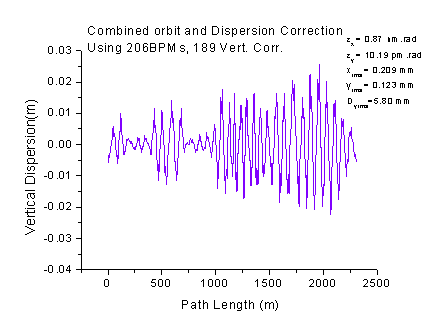
Figure 1: Vertical dispersion around the ring after combined orbit and dispersion correction.
Though the orbit and dispersions are corrected with desired emittance values, still it may not solve the problem completely. The control over vertical dispersion at damping wiggler sections may not full filled to desired values, as it is not decoupled from orbit correction.
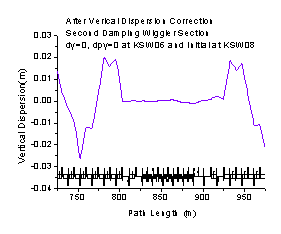
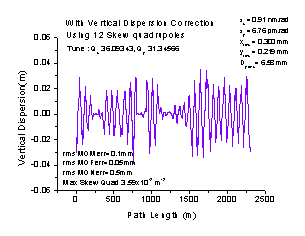
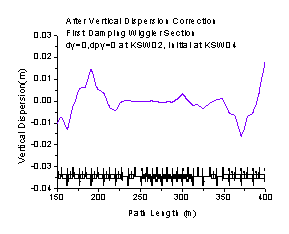
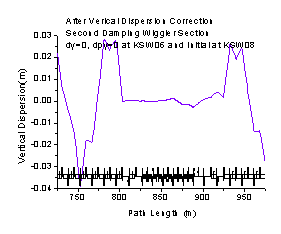
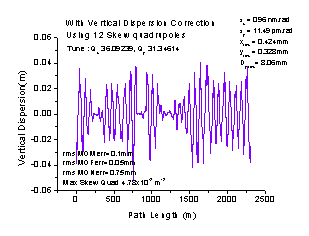
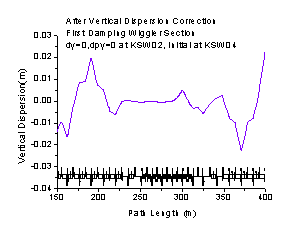
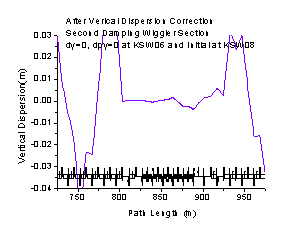
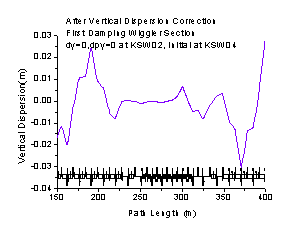
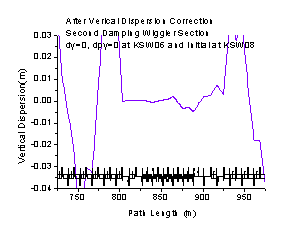
Case 2: First the closed orbit and the horizontal dispersion are corrected using procedure of Case 1. Further, the local vertical dispersion and its derivatives are corrected using local bump method by means of 4 skew quadrupoles at the two damping wiggler section and the new DBA section. The results of vertical dispersion correction for a specific case are shown in Fig.2 at the damping wiggler section and the new DBA section.
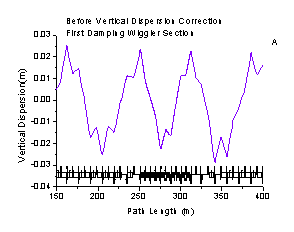
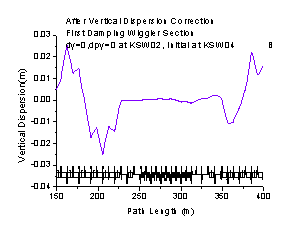
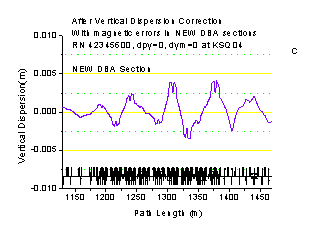
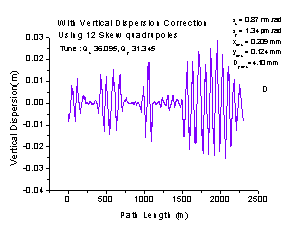
Figure 2: Vertical dispersion (A) 1st damping wiggler section before correction, (B) 1st damping wiggler section after correction, (C) at the new octant after correction and (D) around the ring after correction.
From Fig.2 (A-B) it is evident that by local correction the vertical dispersion is not disturbed out side the range of correction in the damping wiggler section. The vertical dispersion is nearly zero at damping wiggler sections while it is around 2 to 3mm at the insertion sections. It is due to the nonzero vertical orbit at the strong quadrupoles in that section. At the insertion section with a b function of 5m and beam emittance of 10pm.rad, we get a beam size of 7mm due to betatron contribution, while the dispersion part will be ~2 - 3mm with a relative momentum spread of 0.001.
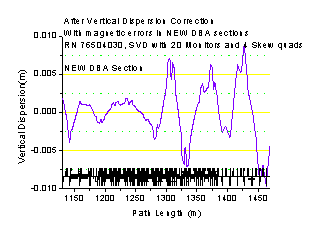
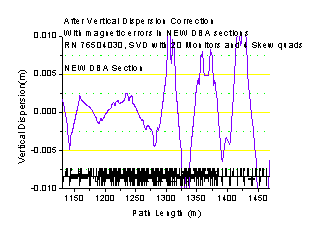
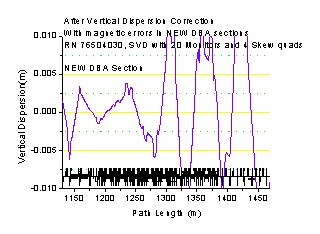
Further more, the vertical dispersion is minimized using 20 BPMs on either side of the 10 insertion devices and 4 skew quadrupoles on either side of the new octant using SVD algorithm. The results shown in Fig. 2C are further minimized by this algorithm, and are shown below.
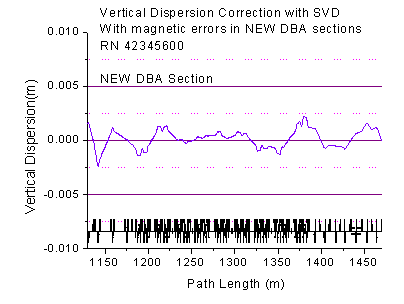
Figure 3: Vertical dispersion after further minimization with SVD algorithm in the new octant.
The results obtained from this are encouraging as the orbit deviations before and after dispersion are below 30mm and the vertical emittance can be maintained with different weighting factors given to BPMs. The skew quadrupole strengths are small such that it can impart small betatron coupling. So, this procedure was repeated for many random cases. The results are shown if Fig. 4, where it is seen that the dispersion is well maintained with in desired 3mm limits on either side of 5m undulator section.
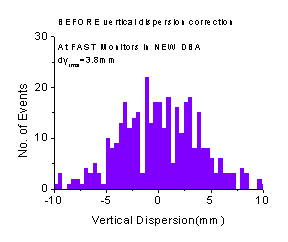
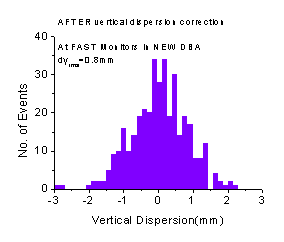
Figure 4: Vertical dispersion before and after correction at monitors on either side of 5m undulators in new DBA section.
Case 3: The vertical dispersion is corrected using 21 vertical corrector magnets placed on either side of 7 old FODO achromats, 20 BPMs in old octant, and using 20 BPMs on either side of the 10 insertion sections of the new Octant. The procedure is the same as described in Case 1, but here only the vertical dispersion is corrected.
The simulation results for dispersion correction using 40 BPMs and 21 vertical steering magnets are shown in Fig. 5. In these simulations, it is observed that the rms vertical dispersion is quite small, i.e. the vertical emittance is much smaller than desired 10pm.rad, which is the case of an over correction. The weighting factor on the degree of correction can be varied to get a moderate correction, which can be a key element to manage the vertical beam emittance. One can notice that on using the vertical correctors as the elements to correct the vertical spurious dispersion leads to larger change in vertical orbit before and after correction, which is ~800mm. This is not desirable. In this case too one can not maintain the vertical dispersion at damping wiggler sections. This correction scheme may not be suitable.
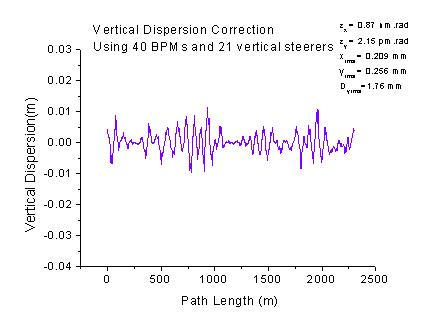
Figure 5: Vertical dispersion around the ring after correction with a few vertical correctors.
On comparison with the three different procedures to correct the spurious vertical dispersion in PETRA III, it is seen that 2nd case, where the vertical dispersion is corrected by use of 12 skew quadrupoles, with small change in vertical orbit before and after correction is most suitable. This provides more flexible control over the vertical dispersion in the damping wiggler sections.
For PETRA III, a scheme to correct the spurious vertical dispersion using a set of 12 skew quadrupoles is almost finalised. Keeping the betatron coupling coefficient low, it is shown that the vertical dispersion can be corrected to desired values at the two damping wiggler sections and in the new DBA section. The present arrangements show promising results with a maximum gradient of 2T/m.
Vertical Dispersion Correction with different monitor reading errors
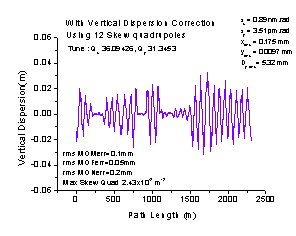
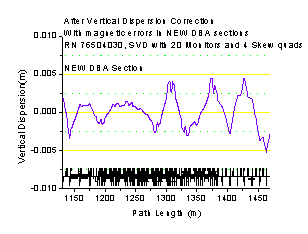
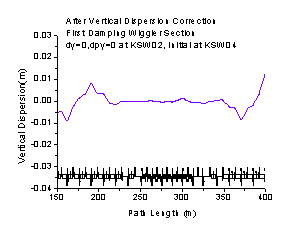
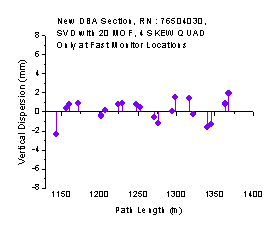
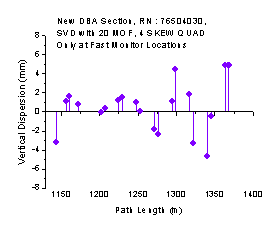
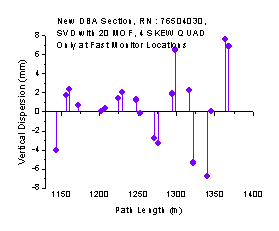
Simulation of spurious vertical dispersion correction with different monitor reading errors to estimate the maximum skew quadrupole strength required to correct the same. The IDs are taken as dipole magnets and the MOM and MOF type monitors in the new octant are taken with fixed reading errors of 100 and 50mm. For different observations the normal type monitor reading errors are varied from 0.1 to 1.0mm. The vertical dispersion correction was carried with 12 skew quadrupoles, first the dispersion is minimised in the new octant with SVD algorithm and the results are put as initial conditions for local dispersion correction in damping wiggler sections. The results are reproduced below.
With rms MOM error=0.1mm, rms MOF error=0.05mm, and rms MON error=0.2mm
With rms MOM error=0.1mm, rms MOF error=0.05mm, and rms MON error=0.5mm
With rms MOM error=0.1mm, rms MOF error=0.05mm, and rms MON error=0.75mm
With rms MOM error=0.1mm, rms MOF error=0.05mm, and rms MON error=1.0mm
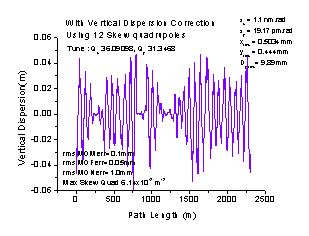
Looking into the vertical dispersion at either side of monitors of all insertion devices in the new octant, we can see that these are gradually increasing with normal monitor reading errors. The vertical beam emittance increases from 3.5pm.rad to 11.45pm.rad, while in last case the vertical dispersion are ~8mm. But though the dispersion function is very awful still the skeq quadrupole strengths are with in the limits of 2T/m gradients.
 0.2mm
0.2mm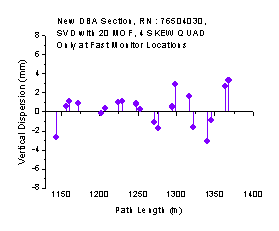 0.5mm
0.5mm
 0.75mm
 1.0mm
1.0mm
Home page of Orbit Movement and Beam Position Control