December 10, 1990
R. FELST
Safety Note No. 2 is concerned with two topics relevant to the safety of the H1-detector and its crew:
the emergency exits in HERA-hall North, and
the fire extinguishing system in the electronic trailer of H1
The urgently needed general alarm system is presently under construction. It will be described in a following note when it is operative. At the request of several H1-members I start with a short description of the safety responsibilities at H1, as I understand them.
The general safety structure is imposed on DESY by the "Landesunfallkasse der Freien und Hansestadt Hamburg", which is an "Institution of Public Law'': The main responsible is the entrepreneur who at DESY is the board of directors. The directors have to delegate their duties concerning safety if they feel unable to fulfill them, and this delegation has to go on until manageable areas are reached. The delegation of responsibilities does not imply that one gets rid of the responsibility.
At DESY the directorate delegated their safety responsibility for the H1-Experiment to the "safety officer'' who is presently me. As I feel unable to fulfill my duties for all parts of the detector. I asked, after consultation, the board of directors to nominate "subcomponent safety officers". The names of these colleagues are listed in table 1 together with the corresponding components and areas.
With the responsibility the board of directors delegated to the safety officers the power to force people to follow the instructions on matters of safety and (to which extent is not clear to me) to provide the necessary safety installations. The safety officers can get experts advice from the safety engineer (Mr. Sindt. tel. 3585 at present) who, however, acts only as a consultant. Furthermore there exist "Sicherheitsbeauftragte" (who for the area of the North Hall is Mr. Seidel at present). These are representatives of the employees (Arbeitnehmer) to consult the employer (Arbeitgeber) and to point out safety risks etc. to him (as everybody is obliged to do) and to motivate their colleagues in matters of safety.
The task of directors and safety officers is a) to provide the necessary safety installation, b) to inform the employees about the relevant safety rules and c) to enforce these rules upon the persons concerned. These tasks are relatively straightforward to meet in hierarchically ordered structures (factories etc.) to which these safety rules are tailored. But the tasks b) and c) are difficult to meet at a laboratory like DESY and especially at H1 with its many collaborating institutes and guests.
In order to help the H1-safety-officers to meet tasks b) and c) it was agreed in the CB-meeting that each institute participating in H1 nominates a person who is responsible to instruct the members of his group on matters of safety. The names of these "group safety responsibles'' are listed in table 2. The safety instructions will be issued by the safety officer in form of safety notes, the present note being the first in this series. I would like to ask every "group safety responsible" to confirm the receipt of these notes.
|
Safety Officer |
Component and Area |
|
W. Bartel |
Construction, installation and operation of the LST's in halls PETRA SW and HERA N |
|
F. Brasse |
Cryogenic of L.A. system in HERA N |
|
J. Buerger |
Test and operation of the inner tracking chambers in halls No. 5 and HERA N |
|
M. David |
Test of L.A. calorimeter in halls No. 5 and HERA N |
|
W. Flauger |
Test of L.A. calorimeter in halls No. 5 and HERA N |
|
D. Lueers |
Test of L.A. calorimeter in halls No. 5 and HERA N |
|
K. Gadow |
Mechanical mounting of the detector in hall HERA N |
|
D. Schmidt |
LST-tests in Lab.II |
|
K. Stephens |
Mounting and test of the forward muon detector in halls PETRA NW and HERA N |
|
U. Struczinski |
Gas supply systems |
|
RWTH Aachen I |
Braunschweig, Wolfgang |
|
RWTH Aachen III |
Struczinski, Wolfgang |
|
Birmingham |
Dowell, John |
|
Brussels / Antwerpen |
Bertrand-Coremans, Chislaine |
|
Cracow |
Janczur, Wlodyimierz |
|
Davis |
Lander, Richard |
|
Dortmund |
Drescher, Andreas |
|
Ecole Polytechnique LPNHE |
Sirois, Yves |
|
Glasgow |
Campbell, Alan |
|
Hamburg, I. Inst. |
Riech, Volker |
|
Hamburg, Il. Inst. |
Schuett, Juergen |
|
ITEP |
Gorichev, Petr |
|
Kosice |
Spalek, Jozef |
|
Lancaster |
Clegg, Arthur B. |
|
Lebedev |
Soloviev, Juri V. |
|
Liverpool |
Dainton, John B. |
|
Lund |
Joensson. Leif |
|
Manchester |
Stephens, Keith |
|
MPI |
Lueers, Dirk |
|
Orsay |
Bizot, Jean-Claude |
|
Paris V1 |
Descamps, Frederic |
|
Prag CSI and Charles Univ. |
Strachota, Jiri |
|
QMWC |
Kamlus, Peter |
|
Rome |
Stella., Bruno |
|
RAL |
Hedgecock, Richard C. |
|
Saclay (Phys. Dept.) |
Cozzika, Georges |
|
Saclay (Techn. Dept.) |
Pailler, Pierre |
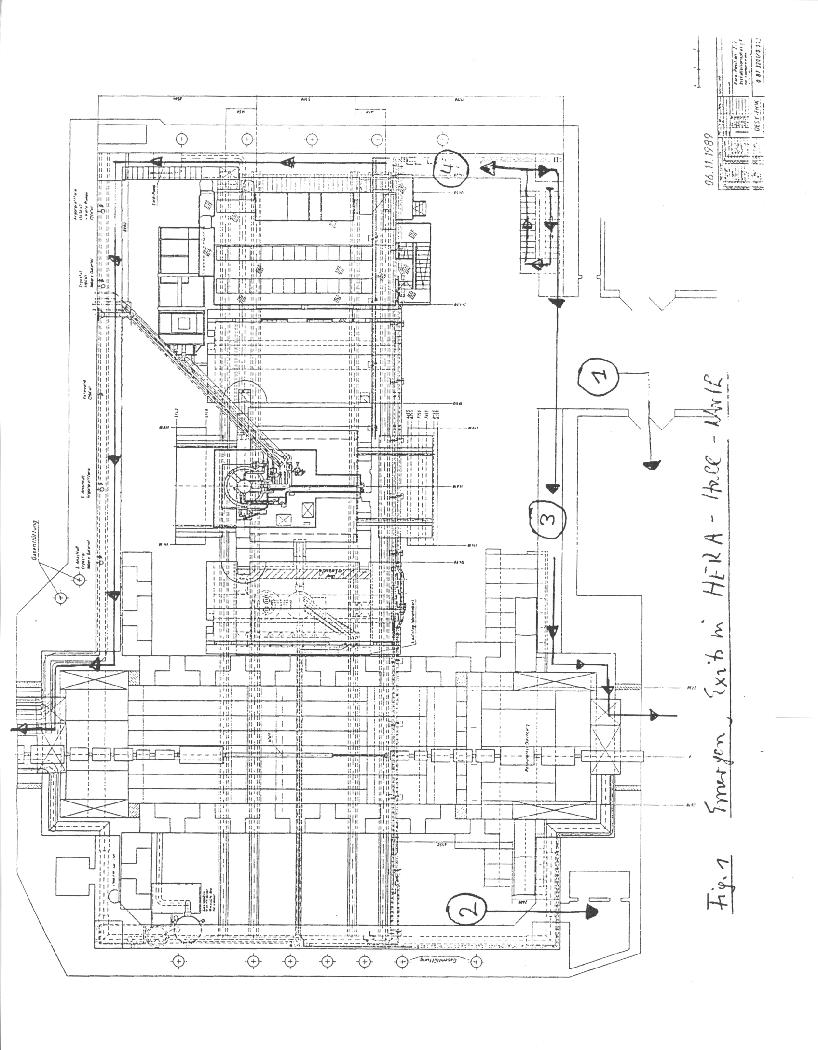
There are 4 emergency exits (in German: Notausgang) in Hall North which are indicated in Fig. 1:
|
Exit (1) |
is the main stair case, which runs next to the elevator. Don't use the elevator in case of a fire, because it can be a trap if it fails. The air-conditioning system is designed to provide an overpressure in the staircase to expel smoke. If smoke is detected, all doors to the staircase close automatically (if they are not blocked by something). It is therefore important for safety that the doors are kept free to close and that no materials are stored in the staircase. If you can't reach exit (1) or it is for some reason (hard to imagine) blocked, use: |
|
|
|
|
Exit (2) |
which is the small staircase located at the north-west corner of the hall. These stairs lead independently from the main stairs to the open air. |
|
|
|
|
Exits (3) and (4) |
lead through the HERA tunnel. One has to take the stairs to the gallery and go along the gallery into the tunnel. After a 1.6 km walk one reaches via (3) the HERA-Hall-West and via (4) the HERA-Hall-East. If the machine is closed you have to open the yellow interlock doors. Doing so the beams will be dumped. The gallery can also be reached via a door from the stairs (2). |
Everybody working in the hall is urgently asked to inspect these emergency exits in order to be able to quickly take them in case of emergency. In principle, from any position of the hall two different escape routes are possible (for the muon platforms the second one is not realized yet). It is important that everybody is always aware which routes to take.
The electronic trailer of H1 has been equipped with an automatic fire extinguishing system. The system is described in the accompanying note by Volker Schroeder who is the H1 expert for this system. As flame extinguishing medium, Halon 1301 (C Br F3) is used. At normal temperatures it is hardly toxic (at a concentration of 6% the lethal dose is reached only after about a thousand hours of inhalation). It becomes, however, toxic, if cracked at high temperatures. You are advised to leave the trailer within the first minute following the alarm. At present the electrical power for the trailer has to be switched off in case of emergency by the power switch on the electrical board mounted at the ground floor outside the wall of the trailer north of its entrance door.