March
- Lower HB-
- Insert HB+/- into YB0
- End installation of barrel muon
horizontal sectors
- Start ECAL underground installation
- Partial services (gas) available in UXC
|
April
- End EB- (first half of barrel ECAL)
underground installation
- Installation of PP1 cable trays
- Installation of ECAL cooling
- Partial services (LV) available in UXC
|
May
- Start installation of EB+
- Install -z forward beampipe
|
|
Updated information should be sent to
cmstimes@cern.ch
|
|
|
Dear
friends
Last
week was a major milestone for CMS. One of the principal technical
design features of the detector is that it is constructed on the
surface before being lowered, in large pieces, underground. The most
critical element of CMS is the central barrel ring, which, in addition
to supporting layers of muon chambers, also supports the
superconducting solenoid and the inner detectors. On 28th February this
ring, including the solenoid, was lowered into the UXC55 underground
cavern. The 1920 tonne piece took about 10 hours to be lowered and
attracted an unprecedented amount of interest from the world press (see
list of reporters etc. here).
Indeed there have been newspaper articles, radio shows and even
television interviews and features. One important thing to note was
that the presence of the media in the CMS assembly site did not disrupt
the normal working operation, in particular the lowering.
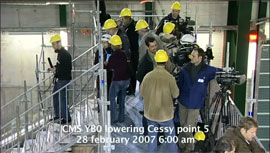
Some members of the press early Wednesday morning. |
The
CERN multimedia team also spent the whole day (from around 5:30am!)
photographing and filming the descent of YB0. A movie of the lowering
(courtesy of Jacques Fichet et al) is already available and can be
downloaded here
(mp4 format, ~30 Mbytes). In the near future this movie will also be
available in high definition format! Watch this space for information!
With best wishes,
Dave Barney
Marzena Lapka
|
|
The HEP group of Çukurova
University (Turkey) in CMS
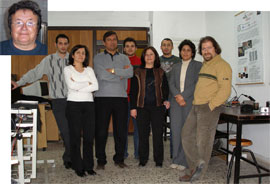
A part of the HEP group of Çukurova University with Gulsen
Onengut (the
leader of the group) in the right top corner. |
The
HEP group of Çukurova University has been a member of the CMS
experiment for almost 10 years. Our group has 7 professors,
5 PhD candidates and around 10 students who are working for their
MSc degree. Our group has mainly contributed to the Hadronic Forward
(HF) calorimeter. Among other things w e: investigated the radiation
hardness of quartz fibers, used as the active element of HF;
constructed and tested the HF online radiation damage monitoring
system; took part in the calibration of HB and HF with LEDs and a
radioactive source; took part in data taking and analysis of MTCC runs
and almost all beam tests of HF. Our group recently started
contributing to the CASTOR project; we tested the timing
parameters and measured dark current and gain for the PMTs of the
CASTOR calorimeter. We have also participated in CASTOR beam test and
data analysis .
Our students working with the FNAL CMS group
contributed
to the testing of CMS TOB silicon detector modules and physics and
detector simulation, i.e. GEANT4 simulations of the CMS Hadronic
Forward Calorimeter in the 2004 beam test, CMS sensitivity to quark
contact interactions with dijets and CMS Hadron Calorimeter response
studies, searches for SUSY in missing transverse energy plus multijet
topologies at  ,
Centrality Measurement in heavy ion collisions for HF, jet shape
studies, validation of calorimeter tower simulation using CMSSW. ,
Centrality Measurement in heavy ion collisions for HF, jet shape
studies, validation of calorimeter tower simulation using CMSSW.
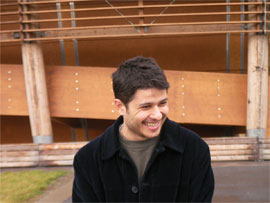
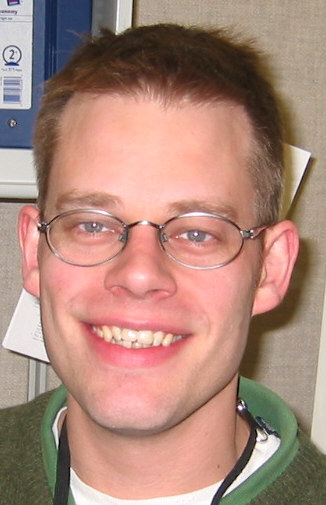
Fatih Kisoglu |
My
name is Hasan Fatih Kisoglu. I usually use "Fatih". I am a master
student in High Energy Physics at Cukurova University in Adana, Turkey.
Two weeks ago I started a new experience out of my country. I had
the opportunity to come to CERN to work for HF+ in HCAL, part of CMS
This
is the begining of my 10 months stay and I wish to familiarize myself
with the Geneva region and the people here. I live in St.Genis-Pouilly
in France. After work or in my free time I usually read books in
physics. Sometimes, I also go downtown to Geneva to discover new
places.
I like the area and have toured around a little. Of course, here is a
little bit different from my country: for example, the streets, the
roads, the buildings, the houses,… The people here are very kind . When
I asked something , like an address, a bus stop, etc. they answer
immediately and very kindly. At first I was reluctant to ask something,
but now I am accustomed.
So, I am at CERN until 15 of December and I hope I
will enjoy my time here .
Download a podcast with Fatih
(~16 Mbyte mp4 file)
|
|
 |
Alignment
of the CMS Tracker
The CMS collaboration is currently constructing
the largest silicon tracking device ever built, with about 17000
detector modules covering an active area of more than 200 m2. To
exploit the capabilities of this precision detector, the positions of
the individual sensors have to be known to the mum level. Tight
mechanical tolerances are enforced during construction and a laser
based alignment system is used to determine the relative positions of
larger substructures. However, the final alignment accuracy can only be
reached with track based algorithms, utilizing distances between
measured hits and reconstructed particle trajectories.
Mathematically, the alignment problem corresponds
to solving a large system of linear equations: In the case of CMS about
45 000 alignment parameters are needed to describe the corrections to
the most sensitive positions and orientations of all detector modules.
Studies have shown that the largest challenge to any alignment
algorithm is to avoid solutions corresponding to unphysical
deformations which leave the overall quality of the fit
unchanged. These modes can be constraint using measurements that link
together parts of the detector not hit simultaneously by tracks from
the interaction point, e.g. cosmic muons and tracks from
beam-halo events.
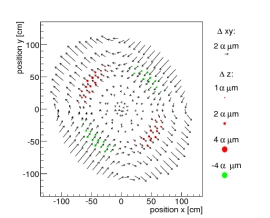
Illustration of an elliptical deformation without influence on the
overall
chi2 if only tracks from the interaction point are utilized. |
The CMS tracker alignment group has investigated three methods to
solve this system: The hits-and-impact-point (HIP) algorithm, the
MILLEPEDE II program, and an approach extending the
Kalman filter used in track fitting. All three algorithms
are being intensively tested on
simulated data using a misaligned CMS detector. The CMS group at
Hamburg University uses MILLEPEDE II, developed by Volker Blobel. This
algorithm takes into account correlations
between all alignment
parameters and even the parameters describing the particle
trajectories. This allows for a one-step solution of the problem,
without iterating over the data.
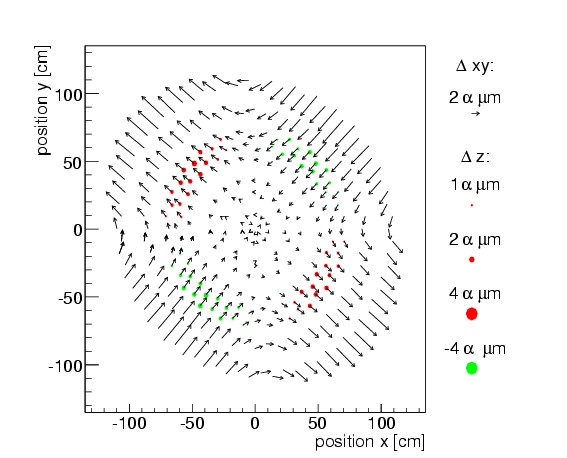
A proof-of-concept study obtained with the MILLEPEDE II algorithm shows
for the
first time that the full CMS tracker can indeed be aligned. Using
estimates for the remaining placement uncertainties (after survey) of
substructures with respect to larger structures turned out to be very
useful. Starting
from a misaligned tracker, the precision reached using muons from Z
boson decays and cosmic rays is 9 mum in the barrel (1
mum in the pixel) and 22 mum in the
endcaps.
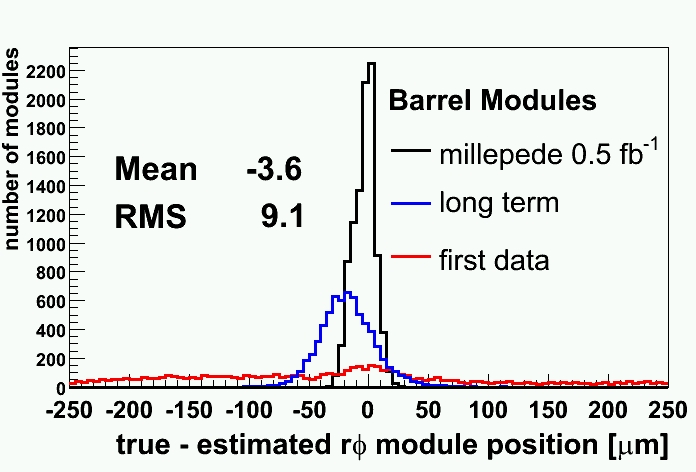
Alignment precision of the most sensitive coordinate (rphi)
for modules in the barrel. |
This result, obtained with 0.5 fb^-1 of simulated data, is even more
precise than what was predicted in the recent physics technical design
report as "long-term scenario". Remarkably, running the program
took
less than 2 hours on a 64 bit processor and required not more than
about 2 GByte of memory. This is an important step on
the way towards a tracker ready for physics analysis in 2008.
|
|
Submitted by: |
|
|
|
|
|
| Markus Stoye, |
|
Georg Steinbrueck |
and |
Gero
Flucke
|
|
CMS
ECAL monitoring system
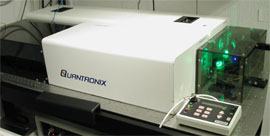
One pair of the lasers, including a Nd:YLF pump laser and a tunable
Ti:Sapphire laser with dual wavelength. |
Light
monitoring will play a crucial role in maintaining the energy
resolution for the CMS lead tungstate (PWO) crystal calorimeter in
situ
at LHC. The scintillation mechanism of the PWO crystals is not affected
by the radiation, and the loss of crystal's light output is due only to
the absorption caused by the radiation induced color centers. The
variation of PWO crystal's light output (damage and recovery) will be
estimated by using a light monitoring system, which measures the
variations of crystal's transmittance.
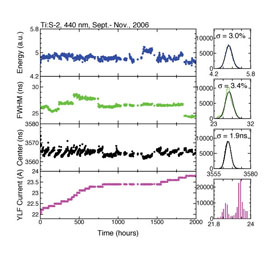
Histories of the laser pulse energy, FWHM, pulse center timing and
corresponding YLF laser pumping current are shown as function of time
for a Ti:Sapphire laser running at 440 nm with the software feedback
for 2,000 hours. The corresponding histogram distributions are shown at
the right. |
The
Caltech group is responsible for the construction, maintenance and
operation of the Light Source and high level Distribution Subsystem
(LSDS) for the ECAL monitoring. The LSDS consists of three pairs of
lasers (a Nd:YLF pump laser and a tunable Ti:Sapphire laser offering
dual wavelength) with corresponding diagnostics, a 3 X 1 optical switch
and a 1 X 88 optical switch. Up to four wavelengths (440, 495, 709 and
796 nm) are available by using the 3 X 1 switch. A total of 88
calorimeter elements (72 half barrel Super Modules plus 16 1/4 endcap
Dees) will be scanned in half hour in situ at LHC. The
primary monitoring wavelength is 440 nm, while the 796 nm
infrared (IR) wavelength is used to check electronics chain. The
intensity of the laser pulse is adjustable in 1% steps up to 1 mJ,
which corresponds to 1.3 TeV equivalent energy deposition in one
crystal. In 2006 a software feedback system was implemented so that the
stability of the laser pulse intensity and FWHM width are maintained at
3% level with a laser pulse timing jitter of less than 2 ns observed in
laser runs lasting for more than 2,000 hours during the ECAL test beam.
The dual blue/green laser systems guarantee 100% availability of 440 nm
in situ at LHC, even during the laser maintenance.
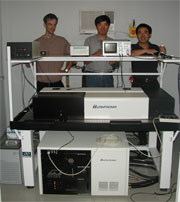
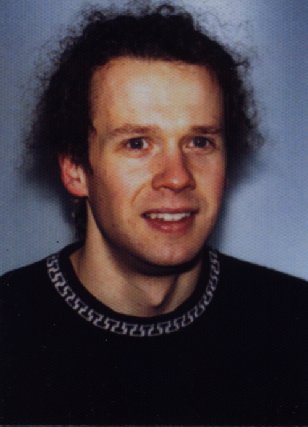
The Caltech laser team during the 2003 commission at H4. From right to
left: optical engineer Dr. Liyuan Zhang, software engineer Dr. Kejun
Zhu and David Bailleux. |
The
Caltech team is lead by Dr. Ren-yuan Zhu with team members of David
Bailleux, Dr. Adi Bornheim, Dr. Liyuan Zhang and Dr. Kejun Zhu. The
first blue/green laser system was commissioned at the H4 test beam site
at CERN in August, 2001. The IR/red laser and the second blue/green
systems were commissioned at CERN in August 2003. In March, 2007, a
blue/green laser and the IR/red laser will be installed and
commissioned in the CMS underground carven at USC55. The other
blue/green laser will remain at the H4 test beam site until the end of
the tests of the ECAL barrel Super Modules and the endcap Dees.
| Submitted by: |
|
|
|
|
Renyuan
Zhu |
and |
David Bailleux
|
|
|
|
|
The
YB0, the acronym used to represent the central barrel wheel, set the
scene of unprecedented attention last week since it is the centerpiece
of CMS and houses the heart of the experiment: the magnet and sensitive
inner detectors ECAL, HCAL and the tracker. The 1920 tonne object was
lowered from the surface hall into the experimental hall on Wednesday
Feb 28th amidst a frenzy of media presence as well. We could not afford
to go wrong!
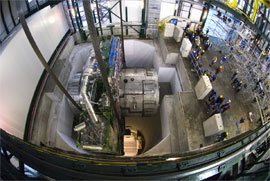
The ground moves beneath YB0 and its 11 hour journey begins. |
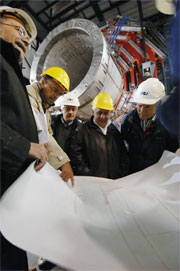
After having worked for over 15 years on this project, Lucien Veillet,
Alain Herve and Hubert Gerwig are making sure that there is no snag for
the imminent lowering. |
YB0
is the heaviest object that has been (and will be) lowered, and even
though the heavy lowering gantry was specified around its weight there
were some fears of getting some oscillations during the lowering
movements, despite the fact that the clearance was of the order of 180
mm or more. In previous cases these oscillations have been of the order
of 20 mm with a maximum of 30 mm. Hence three cameras were attached on
the vacuum tank to be able to see the choke points where services
installed on top of the tank would come very close to the barrier of
the "hydrostatic gallery".
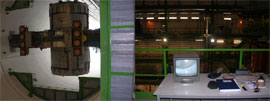
Close to the barrier and amply clear of it, as you can see from the TV
display of one of the cameras mounted on the vac tank. |
In the end everything went extremely smoothly and
the oscillations were less than a couple of centimetres.
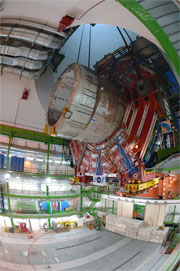
Enroute towards joining the positive endcap in the cavern. |
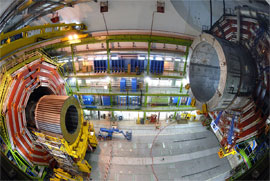
YB0 makes it safely underground. |
The touchdown was greeted by cheers and champagne!
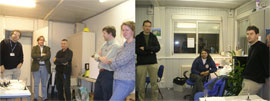
Some relaxing moments after the long day! |
The
next piece to be lowered is the HB minus, and work has begun in all
earnest to keep to the schedule on the other activities.
| Submitted by |

Archana Sharma |
|
|
CMS Outreach Meeting during CMS
Week
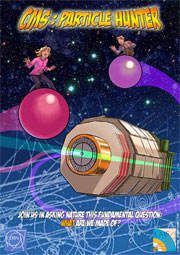
The front cover of the CMS comic-book 4-page bochure |
On
Friday 2nd March a CMS Outreach meeting took place at CERN. Some of the
highlights were the distribution of the new CMS Movie DVD (available
from the CMS secretariat) and the 4-page comic-book brochure. The
latter is about to be sent for volume printing and should be available,
in English, French, German and Italian, by April.
The full agenda, with all presentations, can be
found at:
http://indico.cern.ch/conferenceDisplay.py?
confId=13123
In
the coming weeks the CMS Times will present some of the Outreach
activities; if anyone wishes to get involved in any of these activities
please send a message to outreach@cern.ch
|
|