
URL: https://www.desy.de/news/news_search/index_eng.html
Breadcrumb Navigation
DESY News: AI unveils weak signals from a haze of noise
News
News from the DESY research centre
AI unveils weak signals from a haze of noise
Researchers from the University of Zurich (UZH) have used convolutional neural networks (CNNs) to effectively filter noise from detector images and hence make scattering signals visible that would otherwise be virtually invisible. By using data from the PETRA III beamline P21.1, the group around Johan Chang, professor at the Physics institute at UZH, trained a deep CNN system such that a 20-fold reduction of the measurement time yielded equally accurate physical information as the long measurement. In their publication in the recent issue of the journal Nature Machine Intelligence the team showcases the effectiveness of their approach for a single-crystal diffraction experiment and demonstrates its potential for faster data collection for other scattering techniques as well.
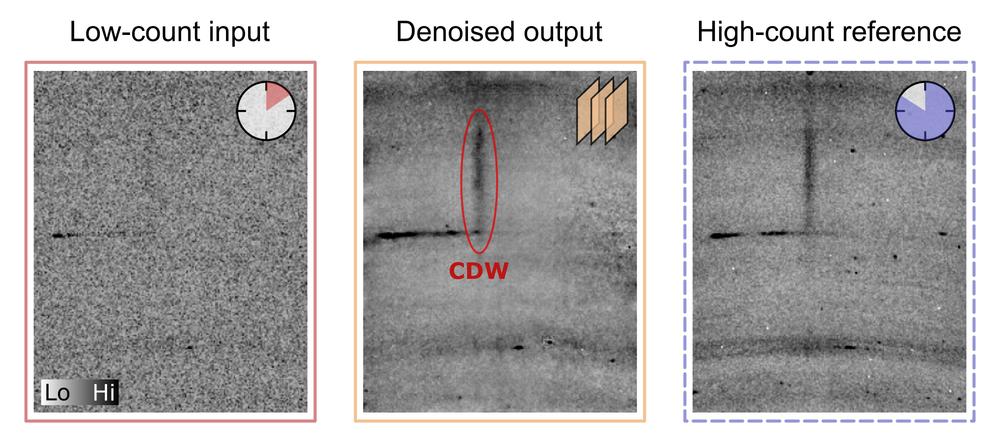
The AI finds the signal in the noise: From the short-term recording (left), the neural network filters out a charge density signal (red ellipse in the centre image), which is as clear as the signal from the 20-fold longer measurement (right). Image: UZH
For a more reliable identification of weaker signals and improving the signal-to-noise ratio, the researchers set up two different neural networks with the aim to “de-noise” the measured data. “As a first step, we collected a dataset consisting of pairs of low-count (LC) and high-count (HC) images with 1 and 20 seconds exposure times respectively,” says Julia Küspert, PhD student in the Chang group. Jens Oppliger, first author of the study and also PhD student in the group, further explains the applied procedure: “We then trained a deep CNN to enhance the weak CDW signal in the noisy low-count data in a supervised machine learning scheme using the corresponding high-count images as reference. Training with more than three thousand such pairs of detector frames took around 10 to 20 hours on a moderate GPU with 10 GB of VRAM. Once trained, the network produces de-noised frames within a fraction of a second.” Although the noise distribution is rather well understood for scattering experiments with 2D detectors, it turned out to be important to work with real LC data as it contains additional noise components from various experimental sources such as readout noise. “We realised that adding simulated noise to the HC images resulted in less reliable noise filtering than training with experimental LC data,” says Jens Oppliger.
Accelerated data acquisition does not only facilitate a highly efficient use of valuable beamtime at synchrotron or free-electron-laser beamlines but it also paves the way to ever more advanced studies of radiation-sensitive samples and ultrafast processes. Generally, the reduced data collection time minimises the X-ray dose accumulated in a sample. Wherever long exposures to X-rays destroy the specimen, e.g. biological tissue or metastable materials, the presented noise filter offers the potential to gain insights into delicate structures that have been inaccessible so far. Very importantly, data-denoising assisted by artificial intelligence (AI) enables the detection of very rapid structural changes that happen e.g. in pulsed high magnetic fields or under laser irradiation with a high repetition rate. “Other traditional noise-reduction techniques applied in imaging or acoustics, such as low-pass and Gaussian filters, oftentimes lead to noticeable visual artifacts for images with high noise levels. Our CNN-based noise filter largely avoids such issues while preserving the scientific content of the measurement. That means we do not modify any part of the physical information contained in the detector images and instead utilise the trained AI model to separate signal from noise,” says Jens Oppliger. The introduced method is not based on any specifics of diffraction and scattering data; hence the research team foresees to test the capabilities of the system to extract weak signals from scattering, spectroscopy, and electron microscopy data in a next step. On the long run, a magnitude of scientific communities could benefit from such kind of AI-based tools designed to efficiently remove high levels of noise.
Reference
J. Oppliger, M.M. Denner, J. Küspert et al., Weak signal extraction enabled by deep neural network denoising of diffraction data.Nature Machine Intelligence 6, 180–186 (2024), DOI: 10.1038/s42256-024-00790-1